
Virgin Base Oil vs Recycled Base Oil: Key Differences Buyers Should Know
Many buyers begin their research by asking a simple question: what is the virgin base oil meaning, and how does it compare with recycled alternatives in real-world procurement decisions?For procurement managers and technical buyers, the answer goes far beyond price. Base oil selection affects product consistency, regulatory compliance, oxidation stability, equipment performance, and long-term operating costs.
This article explains the key differences between virgin and recycled base oils so buyers can make more informed purchasing decisions.
What Is the Virgin Base Oil Meaning?
Virgin base oil refers to base oil produced directly from crude oil refining or from primary petrochemical feedstocks through approved refining processes.
It has not previously been used in machinery, engines, or industrial systems. Because it originates from fresh feedstock, virgin base oil typically offers greater purity, more predictable composition, and more consistent performance characteristics.
In practical procurement terms, virgin base oil is often preferred when product quality, formulation stability, and strict technical specifications are top priorities.
What Is Recycled Base Oil?
Recycled base oil, sometimes called re-refined base oil, is produced by collecting used lubricating oil and processing it to remove contaminants, degradation products, water, fuel residues, metals, and other impurities.
Modern re-refining technologies can produce recycled base oils with strong performance properties, depending on the quality of the feedstock and the sophistication of the treatment process.
Recycled base oil is often considered by buyers seeking cost efficiency, sustainability benefits, or compliance with environmental procurement goals.
Key Differences Between Virgin and Recycled Base Oil
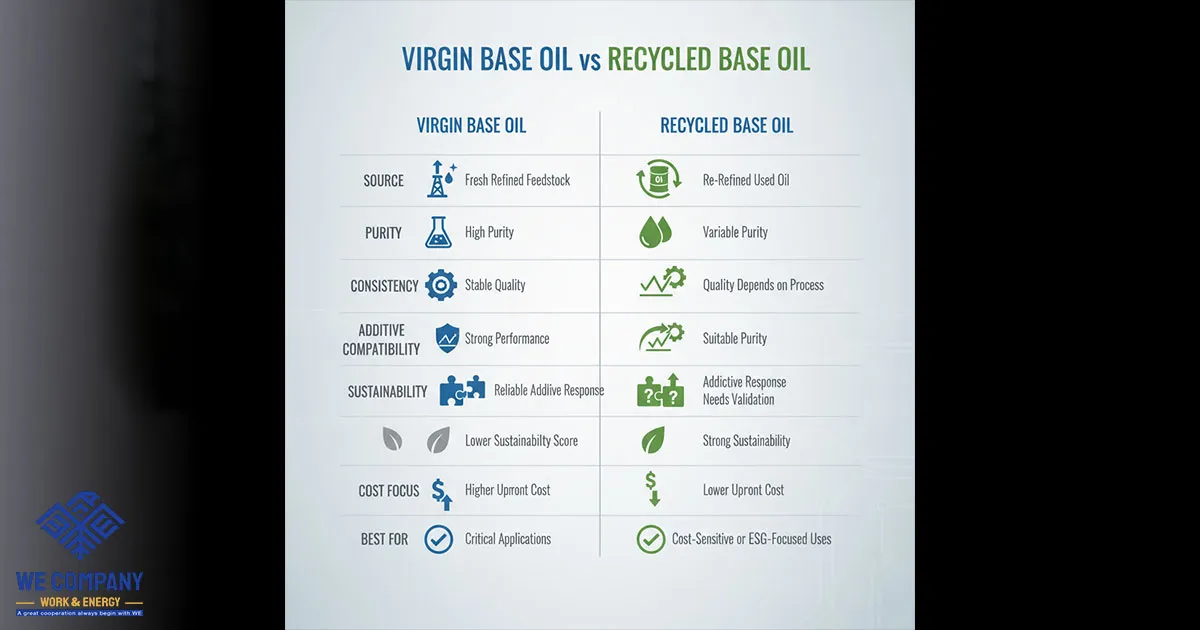
1. Source and Production Process
The most fundamental difference is origin.
Virgin base oil is manufactured from new raw materials through refining processes such as solvent extraction, hydroprocessing, or severe hydrocracking.
Recycled base oil starts as used oil that must be collected, sorted, and treated before it can return to the market.
This distinction matters because the feedstock quality of virgin oil is more controlled at the beginning of the production chain, while recycled oil quality can vary based on collection methods and re-refining standards.
2. Purity and Consistency
For technical buyers, consistency is one of the most important decision factors.
Virgin base oil usually offers:
- More uniform molecular composition
- Lower contamination risk
- More stable viscosity characteristics
- Better batch-to-batch consistency
Recycled base oil can also perform well, but its quality depends heavily on the input used oil stream and the effectiveness of the re-refining process.
High-quality producers can achieve strong results, but procurement teams should verify quality controls carefully.
3. Performance in Critical Applications
Virgin base oil is often favored in demanding applications where high oxidation stability, thermal resistance, and long service life are required.
These may include:
- Automotive lubricants
- Industrial hydraulic oils
- Turbine oils
- Compressor oils
- Transformer oils
- High-performance greases
Recycled base oil may be suitable for selected industrial or less demanding applications, particularly when supported by strong technical documentation and testing.
However, for mission-critical systems, buyers often prefer virgin base oil because of its predictable performance.
4. Additive Response and Formulation Stability
Lubricant formulators need base oils that respond consistently to additive packages.
Virgin base oil generally provides a cleaner and more stable foundation for blending, which can help ensure:
- Better additive compatibility
- Improved shelf stability
- More reliable finished lubricant performance
- Reduced formulation risk
Recycled base oil may still be usable in certain blends, but any trace impurities or variation in composition can influence additive behavior.
This is especially relevant for technical buyers working with strict formulation tolerances.
5. Environmental Considerations
One of the strongest advantages of recycled base oil is sustainability. Re-refining used oil supports circular economy goals, reduces waste, and can lower the environmental footprint associated with virgin raw material extraction.
For companies with ESG targets or green procurement policies, recycled base oil may be an attractive option.
That said, environmental benefits should still be balanced against quality requirements, application needs, and compliance demands.
6. Cost and Total Value
At first glance, recycled base oil may appear more cost-effective due to a lower purchase price in some markets.
However, experienced buyers know that price alone is not the best indicator of value.
Virgin base oil may offer:
- Lower risk of quality variation
- Fewer formulation issues
- Better equipment protection
- Reduced maintenance or failure risk
- Easier compliance with OEM or regulatory requirements
When evaluating suppliers, procurement managers should consider total cost of ownership rather than unit price alone.
How Buyers Should Evaluate Virgin vs Recycled Base Oil
When comparing options, procurement and technical teams should ask suppliers the following questions:
- What is the source of the base oil?
- Is the product virgin, re-refined, or blended?
- What quality certifications are available?
- Can the supplier provide a recent certificate of analysis?
- What are the viscosity index, sulfur content, flash point, and pour point values?
- How consistent is the product across batches?
- Has the oil been tested for oxidation stability and contaminant levels?
- Is the product suitable for the intended application and performance standard?
These questions help buyers move beyond marketing claims and focus on verified technical data.
When Virgin Base Oil Is the Better Choice
Virgin base oil is typically the better option when:
- Product consistency is critical
- Equipment operates under severe conditions
- OEM approvals are required
- Formulations demand high purity
- Long drain intervals or high stability are essential
- End users expect premium performance
For procurement managers serving quality-sensitive industries, virgin base oil often provides greater confidence and lower operational risk.
When Recycled Base Oil May Be Suitable
Recycled base oil may be a viable choice when:
- Sustainability targets are a major priority
- The application is less technically demanding
- A qualified supplier can prove consistent re-refining quality
- Cost optimization is important
- The buyer has completed sufficient lab and field validation
The key is not to assume recycled oil is automatically inferior or virgin oil is automatically necessary in every case.
The right choice depends on application, supplier reliability, and technical requirements.
Final Thoughts
Understanding the virgin base oil meaning is the first step toward making smarter sourcing decisions.
Virgin base oil offers clear advantages in purity, consistency, formulation stability, and high-performance applications.
Recycled base oil can offer environmental and cost benefits, but it requires closer technical evaluation and stronger supplier verification.
For procurement managers and technical buyers, the smartest approach is to compare both options based on performance data, application fit, and long-term value.
A well-informed base oil decision can improve product quality, reduce operational risks, and support both commercial and technical objectives.
Download Technical Comparison
If you are evaluating supply options for your business, download our Technical Comparison guide to compare virgin and recycled base oil specifications, performance factors, and sourcing criteria side by side.




No comment